

The Five-Minute EV
BYD’s fast-charging claim is not just a battery story. It is a grid, infrastructure, tariff, standards and investment story.

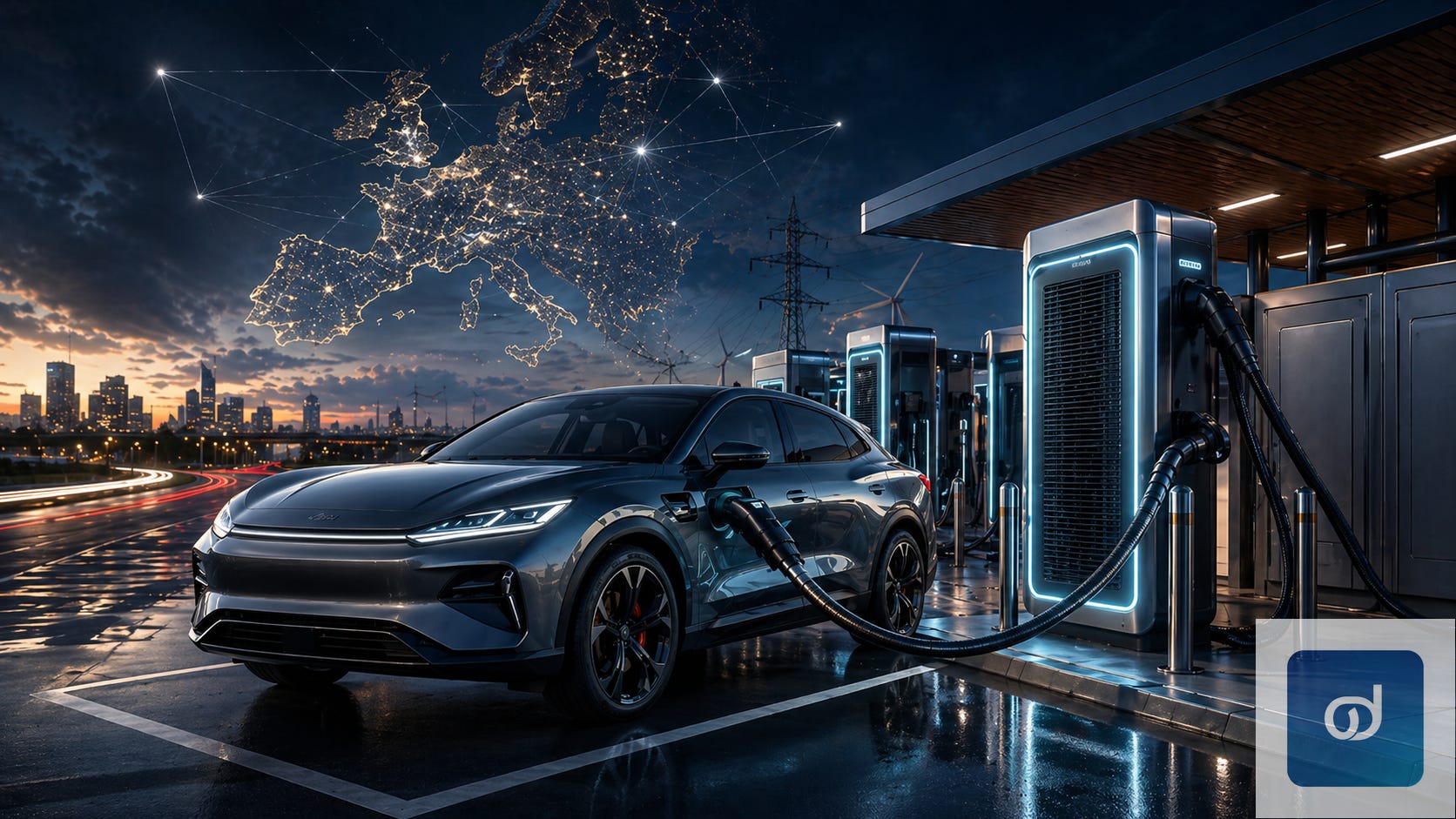
BYD’s fast-charging story is powerful because it attacks one of the remaining psychological advantages of petrol cars: refuelling time. The company’s official claim is that its Super e-Platform can achieve 1 megawatt of charging power and add 400 km of range in five minutes. BYD’s own announcement presents this as refuelling-time equivalence rather than just a charging upgrade; Reuters also reported the 1,000 kW and 400 km in five minutes claim at launch.
That does not make the claim irrelevant. It makes it system-sensitive. The wrong reaction is to dismiss it as impossible simply because most public chargers today cannot do it. The equally wrong reaction is to treat it as proof that EV adoption has been solved. The more precise interpretation is that BYD is trying to shift the adoption debate from “can an EV go far enough?” to “can an EV refuel quickly enough?”
The more grounded version of the story comes from follow-up reporting. Reuters says BYD is pushing flash charging to target hesitant consumers, with claims of charging from 20% to 97% in under 12 minutes and plans for 20,000 flash-charging stations in China plus 6,000 internationally within a year. That is still aggressive. But it is also more useful than the slogan because it raises the right questions: over what state-of-charge window, at what temperature, with what battery degradation, and at what type of charging site?
2. The physics check: 1 MW is not magic, but it is a large local load
A 1 MW charger running for five minutes delivers about 83.3 kWh before losses:
1,000 kW x 5/60 hours = 83.3 kWh
If that produces 400 km of claimed range, the implied energy intensity is roughly 20.8 kWh per 100 km before losses and test-cycle adjustments. For a large EV under favourable assumptions, that is not absurd. But it shows why the headline is not just about charger branding. It requires the vehicle to accept a very high power pulse and the site to deliver it.
This calculation is useful because it identifies the true shift. The problem is not whether enough energy exists. It is whether enough power can be delivered locally, repeatedly, safely and economically.
3. The vehicle stack: high voltage, high current, thermal control and degradation risk
BYD says the platform combines flash-charging batteries, a 1,000V-class architecture, silicon carbide power chips and high-speed drive components. The voltage point matters because higher voltage reduces current for the same power. Lower current helps with resistive losses and thermal stress, although BYD’s own headline still implies extremely high current as well as high voltage.
But fast charging is not only a power-electronics problem. It is also a battery-health problem. Extreme fast charging raises issues around heat generation, lithium plating risk, cell-to-cell thermal gradients, pack cooling and repeated-cycle degradation. Studies of fast charging repeatedly show that temperature and current distribution are not second-order details (Nature Communications; Applied Energy). Even small internal thermal gradients can accelerate uneven degradation, and fast-charge strategies for LFP cells show strong interactions between charging profile, temperature and safety/degradation pathways.
The question is not whether a fresh pack can accept a very high-power charge once. The investable question is whether it can do so repeatedly across seasons, state-of-charge windows, battery ages and warranty conditions without unacceptable degradation.
4. Europe’s current charging baseline: good coverage, different power class
Europe is not infrastructure-empty. The IEA Global EV Outlook 2025 reports that public charging points have doubled globally since 2022 and that Europe has stronger highway fast-charging coverage than many other markets. The IEA executive summary says over three-quarters of European highways have a fast-charging station at least every 50 km.
The European Alternative Fuels Observatory provides the live infrastructure baseline for the EU, with recharging infrastructure data updated monthly. ICCT reported that Europe had roughly 1.14 million public charging points by end-2025, more than four times the 2020 level.
The problem is not absence; it is class. The EU Alternative Fuels Infrastructure Regulation requires car and van charging pools on the TEN-T core network at least every 60 km by end-2025, with at least 400 kW total output and at least one 150 kW charging point. By end-2027, those pools must rise to 600 kW total output with at least two 150 kW points. That is meaningful policy. But compare it with BYD’s claim: AFIR’s early passenger-car requirement is a few hundred kilowatts per pool; BYD is talking about 1 MW to one vehicle.
This is why the European question cannot be answered by counting plugs alone. Plug count matters for access. But BYD-style charging depends on power density, site capacity and the ability to allocate power dynamically across bays.
5. The grid reality: the charger becomes a distribution-network project
A single 1 MW charge point is already a major local load. A hub with eight such bays could theoretically draw 8 MW before site losses, lighting, cooling, retail loads or stationary battery charging. At that point, the project is not simply a retail installation. It becomes a medium-voltage connection and distribution-planning problem.
European grid institutions are already warning that the grid is becoming the bottleneck for electrification. The European Court of Auditors’ 2025 review on making the EU electricity grid fit for net zero highlights delays and the scale of grid expansion required. Eurelectric’s work on distribution-network connection queues describes rising capacity constraints and delays caused by the rapid growth of connection requests across renewables, transport electrification, heating and industrial decarbonisation.
That points to the likely European architecture: not isolated 1 MW posts everywhere, but engineered charging hubs with medium-voltage grid connection, transformer capacity, dynamic power sharing and often on-site stationary storage. Eurelectric's Distribution Grids Handbook notes that assets such as EV charging stations are increasingly connected at distribution level because of consumer proximity and capacity size. The fast-charging site therefore becomes part of local network planning, not just transport infrastructure.
6. The economics: utilisation decides whether the asset is investable
Ultra-fast charging economics are defined by a simple tension: the driver values very high peak power because it saves time, while the operator has to finance equipment, land, civil works, grid connection, transformers, software, maintenance and electricity costs for an asset whose utilisation may be uncertain.
Research on DC fast charging repeatedly finds that utilisation and tariffs are decisive. A recent NREL-linked corridor fast-charging economics study found low-utilisation corridor stations to be roughly six times more expensive per kWh than the average and stations subject to demand charges around 40% more expensive than those without them. A separate NREL assessment of DC fast-charging viability also identifies demand charges and electricity retail prices as major factors affecting station profitability. Earlier work by Muratori and co-authors found that DC fast-charging electricity costs vary greatly and that demand charges create high average electricity costs at low utilisation, with costs falling as utilisation rises.
In a nutshell, the faster the charger, the stronger the consumer proposition. But the faster the charger, the more exposed the operator becomes to peak-capacity costs if the site is not heavily used.
7. Standards and compatibility: the risk of a fast charger that few cars can use
Megawatt charging is not a fantasy category. It already exists as an industry direction for heavy-duty vehicles. SAE J3271 is a system-level standard covering charging equipment and control elements from the point of utility interconnection to the vehicle interface. CharIN frames the Megawatt Charging System (MCS) primarily around trucks and buses, where very large battery packs and tight operational dwell times require much higher power.
For passenger cars, the strategic issue is interoperability. Europe’s current public charging ecosystem has been built around CCS and a regulatory push toward open access, payment transparency and minimum service standards. BYD’s system can help accelerate the technical frontier, but investors will hesitate if a 1 MW site risks becoming a brand-specific or narrow-fleet asset.
A European megawatt passenger-charging network would need compatibility rules before it needs marketing slogans: connectors, communication protocols, payment, cybersecurity, safety certification, warranty treatment and transparent power-rating disclosure.
8. Why the rollout would be uneven across Europe
The right unit of analysis is not “Europe”. It is corridor by corridor, distribution-network zone by distribution-network zone. Europe has high EV penetration and strong charging coverage in some markets, but grid availability, permitting speed, land access, charger utilisation and consumer behaviour vary sharply.
The first viable sites would likely be motorway corridors, airport/taxi hubs, fleet depots, high-income urban charging hubs, retail parks with high traffic, and routes with limited home-charging access. The slower sites would be rural locations with low throughput, constrained distribution networks, difficult land-use planning or weak EV uptake.
This matters for policy. A purely market-led rollout would prioritise high-utilisation nodes. That is efficient, but it can leave coverage gaps. A universal-coverage strategy can fill those gaps, but it may require public support where utilisation is too low to recover fixed costs. This is the same logic that appears in corridor fast-charging economics: excluding stations that fail cost parity can improve commercial returns but reduce geographic coverage.
9. What it would take in Europe
Assuming BYD has the vehicle technology, Europe would need a package rather than a single intervention. The package has five parts.
1. First, grid-ready hub planning. Governments and DSOs would need to identify motorway and urban nodes where several MW of capacity can be made available ahead of demand. This means grid-capacity mapping, anticipatory investment and standardised connection processes.
2. Second, battery-buffered charging where the grid is constrained. Stationary batteries can allow a site to draw more steadily from the grid while delivering short 1 MW bursts to vehicles. This reduces peak pressure but adds capex, land requirements and battery-management complexity.
3. Third, tariff design that recognises flexibility. If charging operators are penalised mainly for peak load, ultra-fast charging becomes difficult to finance. Tariffs need to distinguish unmanaged peaks from flexible, buffered or grid-supportive operation.
4. Fourth, modular and interoperable charger design. The early fleet will be mixed. Most European EVs will not accept 1 MW. Sites should therefore allocate power dynamically across 150 kW, 350-400 kW and future megawatt-capable vehicles rather than strand capacity in dedicated posts.
5. Fifth, a clear investment model. The likely bankable model combines anchor demand from high-throughput users, retail co-location, public risk-sharing for socially useful low-utilisation corridors and transparent standards that reduce stranded-asset risk.
10. Claims, opportunities, constraints: the balanced read
The opportunity is real. If five- to twelve-minute charging becomes repeatable, reliable and widely available, it compresses one of the clearest behavioural disadvantages of EVs. It would be especially important for drivers without home charging, high-mileage users, taxis, fleets and long-distance travel. It would also change how consumers compare EVs with petrol cars: not just on total cost, but on convenience.
But the constraint is equally real. Europe does not merely need faster chargers. It needs grid-ready charging hubs. That means local power capacity, medium-voltage connections, transformers, land, planning consent, dynamic power management, stationary storage in constrained areas, transparent standards, and tariffs that do not punish the very peak-power capability the consumer values.
BYD may be moving the bottleneck. Not from “EVs cannot charge fast enough” to “problem solved”, but from the battery pack to the built environment. The European test is therefore not only technological. It is infrastructural, financial and regulatory.
That is what makes the story interesting. The five-minute EV is not fantasy. But it is not yet a European mass-market condition. It is a system challenge waiting to be built.
Sources and reference links
Key sources used in this draft. Links are embedded for Substack conversion and further checking.
1. BYD Super e-Platform announcement
2. Reuters on BYD 1,000 kW charging platform
3. Reuters on BYD flash charging and overseas rollout
5. IEA Global EV Outlook 2025 - charging infrastructure
6. IEA Global EV Outlook 2025 - executive summary
7. European Alternative Fuels Observatory
8. ICCT on European public charging points
9. Reuters on Spark Alliance ultra-fast charging network
10. Reuters on ACEA charging gap
11. European Court of Auditors grid review 2025
12. Eurelectric on distribution connection queues
13. Eurelectric Distribution Grids Handbook
14. ACEA European EV Charging Infrastructure Masterplan
15. NREL corridor fast-charging economics study
16. NREL assessment of DC fast charging viability
17. Muratori et al. on DC fast-charging electricity rates
18. NREL future demand for EV charging infrastructure
19. Nature Communications battery thermal gradients
20. Applied Energy fast charging degradation and safety